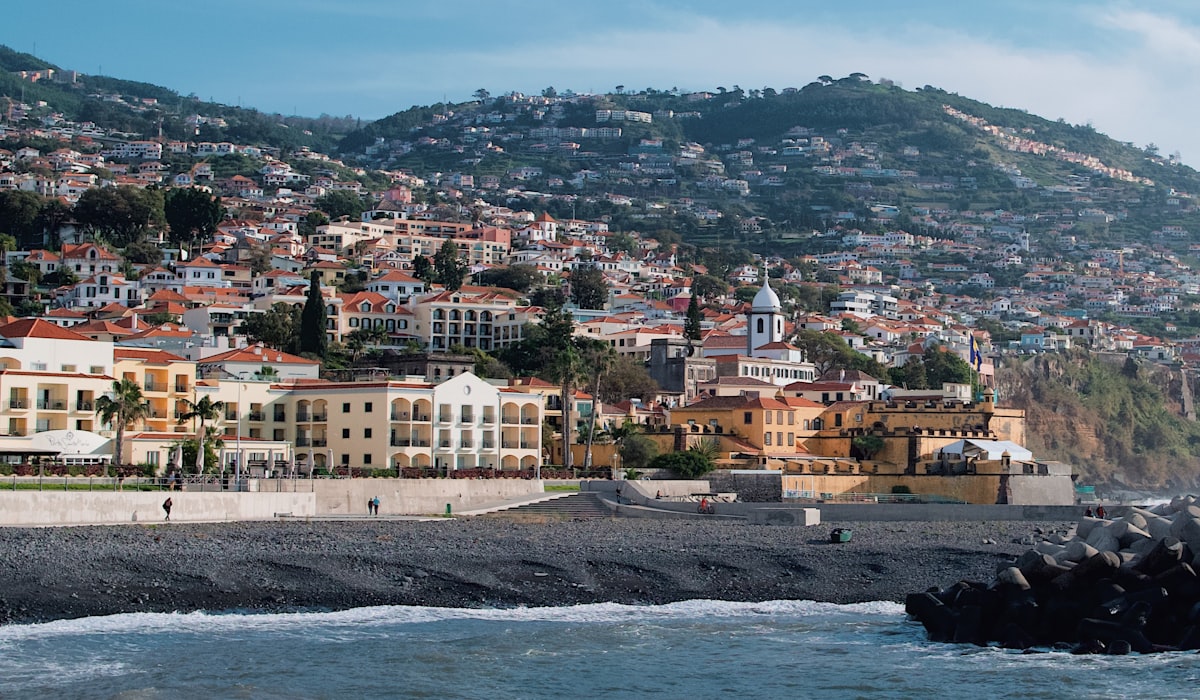
Funchal's Zona Velha is the oldest quarter of the city and the closest one to the cruise terminal. In a two-hour walk you can see the painted doors of Rua de Santa Maria, the 1614 Fortaleza de São Tiago, the Art Déco Mercado dos Lavradores of 1940 and the base station of the Monte cable car, all within a few hundred metres of each other, and all on foot.
What is the Zona Velha, and why does it matter?
The Zona Velha, or Old Town, is the historic core of Funchal, built around the Santa Maria quarter where the city began. It runs along the seafront east of the harbour, and it is the part of Funchal a cruise passenger reaches first on foot. Narrow cobbled streets, fishermen's houses, a fortress and a market sit within a few hundred metres.
The Zona Velha was among the first areas of Funchal to be settled, and its density of old streets and buildings is the reason it is treated as heritage. For decades much of it was run down. Since 2010 the painted doors of Rua de Santa Maria turned the quarter into an open air gallery, and that turnaround is, in itself, a chapter of Funchal's recent tourism history.
Mendonça Supermarkets has stood on Rua Dom Carlos I, one of the Old Town's streets, for more than 30 years, since before the painted doors reached this end of the Zona Velha. We watch the same neighbourhood the guidebooks describe fill and empty with each ship, which is the reason this guide is written from the street rather than from a map.
How far is Funchal Old Town from the cruise terminal?
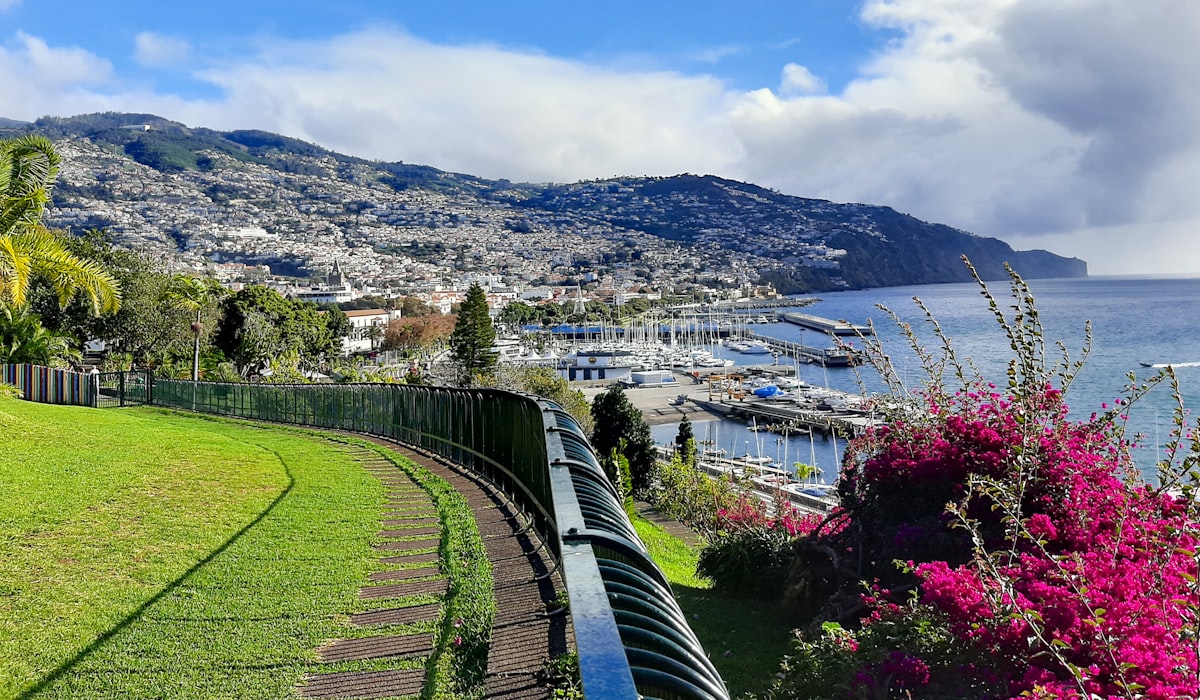
The Old Town sits immediately east of the harbour, so most of it is a short, flat walk from where the ships dock. You leave the terminal, follow the Avenida do Mar seawards, and the Jardim do Almirante Reis and the cable car base mark the entrance to the Zona Velha. No taxi, no bus and no tour booking are required.
This is the most practical section of the guide, because it answers a question cruise passengers ask every day. Keep to visible landmarks rather than street names: from the terminal, walk with the sea on your right along the Avenida do Mar, pass the marina, and continue until you reach the Jardim do Almirante Reis, the small garden where the Funchal cable car begins. Rua de Santa Maria opens just behind it.
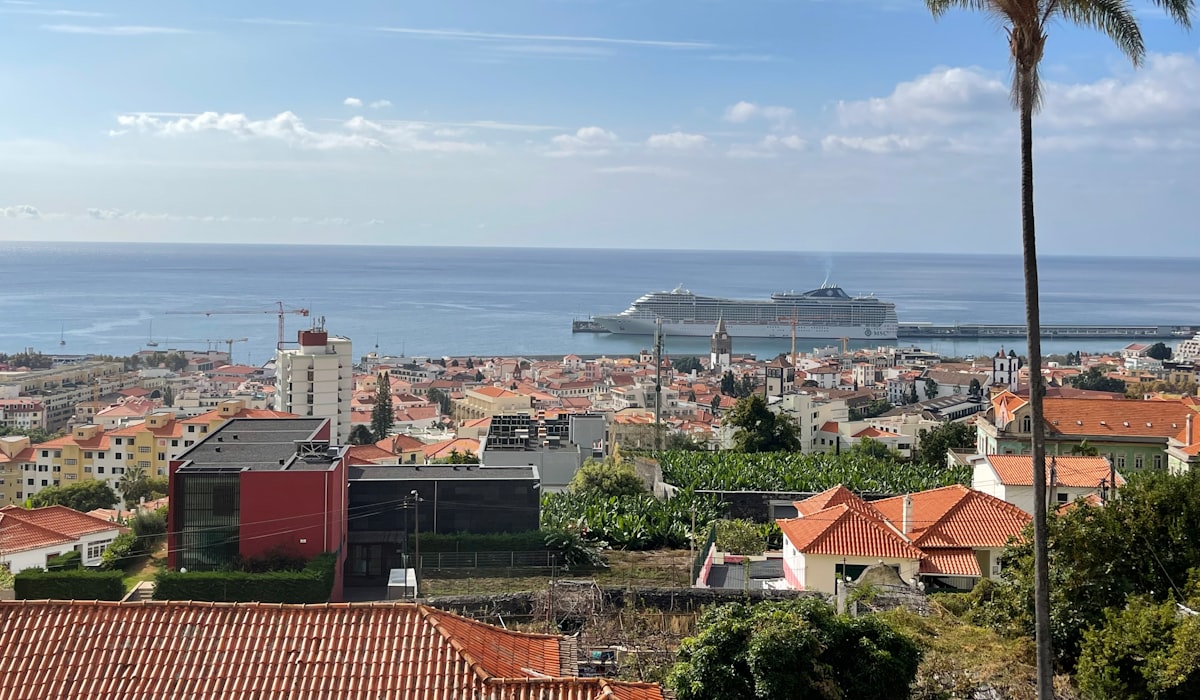
The scale matters. In 2025 the Porto do Funchal recorded 331 cruise calls and a record 746,257 cruise passengers, according to APRAM, the Madeira ports authority, and cruise passenger numbers kept rising into early 2026. Almost all of that footfall enters the city through the same seafront corridor, which is why the Old Town feels crowded within an hour of a large ship arriving.
Why are the doors in Rua de Santa Maria painted?
The painted doors are the Arte Portas Abertas project, started in 2010 by the photographer José Maria Zyberchema to bring life back to a neglected street. Artists were invited to paint the doors of abandoned houses and shops. There are now around 200 of them, mostly in Rua de Santa Maria, and seeing them is free because it is an open street.
The project worked because it turned the problem into the attraction: the doors chosen were on empty, closed-up houses and shops, so painting them gave a dying street a reason to be visited. Madeiran figures from art and design took part, among them the architect Paulo David and the designer Nini Andrade Silva. Over time the idea spread from Rua de Santa Maria to neighbouring streets, including Rua Dom Carlos I.
One practical note: the doors change. Some are repainted, some fade and some disappear as buildings are used again, so no single door is guaranteed to be there on the day you visit. Treat Rua de Santa Maria as a gallery that rotates rather than a fixed set of images, and photograph what catches your eye rather than hunting for one specific door.
What is Fortaleza de São Tiago, and is it worth going in?
Fortaleza de São Tiago is the yellow fortress at the eastern end of the Old Town. Construction began around 1614 under Jerónimo Jorge, a royal master builder, and was finished by his son Bartolomeu João. It was built to defend Funchal from corsair raids, closing the city's eastern defences. The sea views from the walls are the main reason to go up.
An Atlantic island on the sea route between Europe, Africa and the Americas was an obvious target for privateers, which is why Funchal built a belt of forts in the sixteenth and seventeenth centuries, and Fortaleza de São Tiago closed that belt to the east. The fortress later served as a military barracks for centuries and, more recently, as a cultural venue. It sits within the Zona Velha, which is classified as a heritage area.
If your time ashore is short, the honest advice is that the yellow facade and the view from outside the walls deliver most of the experience, and you can see them without paying to go in. Opening hours and any entry ticket change, so check the current details on an official source such as Visit Madeira before you plan around it.
What can you see inside Mercado dos Lavradores?
Mercado dos Lavradores opened in November 1940 to a design by the architect Edmundo Tavares, in Art Déco style. The facade, main entrance and fish hall carry azulejo tile panels by João Rodrigues with regional themes. Inside there is fruit, vegetables and flowers on the upper levels, and a fish hall on the lower floor. It is closed on Sundays.
What you will actually see is a working market: flower sellers in traditional dress near the entrance, stacked Banana da Madeira and passion fruit upstairs, and, in the fish hall below, the black scabbard fish (espada preta) that is a Funchal speciality, laid out whole. The azulejo panels on the walls are worth a minute on their own, since they show island scenes from the year the market opened.
One useful warning that guidebooks rarely give: on the upper fruit stalls it is common to be offered a slice to taste, and prices there are aimed at visitors, so ask the price before you accept anything. For fixed prices on regional products to take home, a supermarket is usually cheaper. For what is genuinely worth buying rather than only tasting, see our guide to what to buy in Funchal.
Should you take the cable car to Monte from the Old Town?
The Funchal cable car (Teleférico Funchal-Monte) leaves from the Jardim do Almirante Reis, at the edge of the Old Town, and reaches Monte in about fifteen minutes. The line runs around 3,200 metres and climbs roughly 560 metres. It opened in November 2000, replacing the tourist role of the old Monte railway that ran from 1893 to 1943.
The real question is whether you have time. The ride up is short, but Monte itself asks for time once you are there, for the church, the gardens and the walk between them. You can come back down by cable car, by taxi or by Monte toboggan. Be clear about the arithmetic: a visitor with four hours ashore who goes up to Monte will spend around half of that time on the trip alone.
What is the Monte toboggan, and where does it come from?
The Monte toboggan is a wicker sledge on wooden runners, steered by two drivers called carreiros. The sledges date from around 1850, when they were the transport Monte residents used to come down to Funchal. Today they are a tourist ride rather than transport, and the descent does not end in the city centre, it ends at Livramento, from where you still have to make your own way back.
How long the round trip really takes
Add the parts up before you commit, using conservative estimates:
- Queue for the cable car: allow 20 to 40 minutes at a busy time.
- Ride up: about 15 minutes.
- Time in Monte (church and gardens): 60 to 90 minutes to make it worthwhile.
- Descent by cable car, taxi or toboggan: 15 to 40 minutes.
- Walk back from the base or from Livramento to the terminal: allow extra.
On those numbers, Monte is a comfortable half day and a rush on a short port call. Keep a full hour of margin before your ship's departure time, and confirm current cable car prices and hours on the official operator's site, because published fares age quickly.
What else is in the Old Town that most visitors walk past?
Two things: the Capela do Corpo Santo, a small fishermen's chapel, and the everyday streets behind Rua de Santa Maria where the neighbourhood still lives. The Old Town is not only the painted stretch. Most visitors photograph one street and leave, and miss the quieter half of the Zona Velha that gives the quarter its character.
The Capela do Corpo Santo was built at the end of the fifteenth century by Funchal's fishermen and dedicated to São Pedro Gonçalves, the patron saint of sailors. Its guild ran it as a form of mutual aid for the fishing community, providing help to the sick and to widows and orphans. The Gothic doorway survives from the original chapel, after changes made in the sixteenth century.
Behind the painted stretch, the Old Town is a real neighbourhood, with its own shops, bakeries and residents doing their daily errands. Mendonça Supermarkets is part of that fabric on Rua Dom Carlos I, one street back from the busiest tables. If you want to see the Zona Velha as more than a photo backdrop, walk one street inland from Rua de Santa Maria and look at how the quarter actually lives.

A two-hour and a four-hour route through the Zona Velha
With two hours, walk Rua de Santa Maria, look at the doors, see Fortaleza de São Tiago from the outside and pass through Mercado dos Lavradores. With four hours, add the cable car to Monte and keep a full hour of margin before your ship's departure time. Both routes end near the terminal so your last stop is a purchase, not a walk.
A two-hour route from the terminal:
- Walk the seafront to the Jardim do Almirante Reis (allow 10 to 15 minutes).
- Rua de Santa Maria and the painted doors (30 to 40 minutes).
- Fortaleza de São Tiago from the outside and the sea views (20 minutes).
- Mercado dos Lavradores, if it is not a Sunday (30 minutes).
- Pick up regional products on Rua Dom Carlos I on the way back.
A four-hour route adds Monte:
- Cable car up from the Jardim do Almirante Reis (queue plus 15 minutes).
- Monte church and gardens (60 to 90 minutes).
- Come back down by cable car or toboggan (15 to 40 minutes).
- Rua de Santa Maria and the market on the way back to the ship.
- Keep one full hour of margin before departure.
When is the Old Town busiest?
The Old Town fills up when ships dock and empties when they sail. Rua de Santa Maria is quietest early, before the restaurant tables take over the street from lunchtime onwards. Mercado dos Lavradores is busiest in the morning and does not open on Sundays, so a Sunday call ashore needs a different plan.
With 331 cruise calls in 2025 and passenger numbers still rising in 2026, the timing of your walk matters more than it used to. If several ships share a day, the seafront and Rua de Santa Maria are at their most crowded in the late morning. The practical window is simple: go early for the market and the doors, leave the middle of the day for something with more space, and shop on the way back.
Frequently asked questions
How long does it take to walk around Funchal Old Town?
You can walk the core of Funchal's Zona Velha in about two hours, taking in Rua de Santa Maria, the outside of Fortaleza de São Tiago and Mercado dos Lavradores. Adding the Funchal cable car to Monte turns it into a half day, so keep a full hour of margin before your ship leaves.
Is Funchal Old Town walkable from the cruise terminal?
Yes. The Zona Velha sits immediately east of Funchal harbour, so most of it is a short, flat walk from where the ships dock. You follow the Avenida do Mar seawards to the Jardim do Almirante Reis, which marks the entrance to the Old Town. No taxi, bus or tour booking is needed.
Are the painted doors in Rua de Santa Maria free to see?
Yes. The painted doors of Rua de Santa Maria are part of the Arte Portas Abertas project and sit on a public street, so seeing them costs nothing. The doors were painted on houses and shops in the Old Town, and you can walk the street and photograph them at any time of day.
When did the painted doors project start?
The Arte Portas Abertas project began in 2010, started by the photographer José Maria Zyberchema to revive Funchal's Old Town. Artists painted the doors of abandoned houses and shops in Rua de Santa Maria. There are now around 200 painted doors, with some extending to neighbouring streets including Rua Dom Carlos I.
How old is Fortaleza de São Tiago?
Construction of Fortaleza de São Tiago began around 1614 under Jerónimo Jorge, a royal master builder, and was finished by his son Bartolomeu João. The yellow fortress stands at the eastern end of Funchal's Old Town and was built to defend the city from corsair raids. It later served as a barracks for centuries.
Is Mercado dos Lavradores open on Sundays?
No. Mercado dos Lavradores is closed on Sundays and on most public holidays. The Funchal farmers' market opens Monday to Saturday, with the shortest hours on Saturday afternoon. If your ship calls on a Sunday, plan the market out of your route and check current opening hours before you go.
How long is the cable car ride to Monte?
The Funchal cable car ride from the Jardim do Almirante Reis to Monte takes about fifteen minutes each way. The line runs roughly 3,200 metres and climbs around 560 metres. It opened in November 2000, taking over the tourist role of the old Monte railway that ran from 1893 to 1943.
What is a Monte toboggan?
The Monte toboggan is a wicker sledge on wooden runners, steered downhill by two drivers called carreiros. The sledges date from around 1850, when they carried Monte residents down to Funchal. Today they are a tourist ride, and the descent ends at Livramento rather than in the city centre, so you still have to get back.
Is Funchal Old Town safe to walk at night?
Funchal's Old Town is a busy restaurant quarter in the evening, especially Rua de Santa Maria, and is generally calm to walk. As anywhere, keep to lit, populated streets and watch your belongings in crowds. Most cruise passengers visit in daylight, between their ship arriving and its departure time.
What should I buy while I am in the Old Town?
For regional products to take home, Madeira wine and Banana da Madeira travel best and keep well. Our full guide to what to buy in Funchal covers each one. Mendonça Supermarkets is on R. Dom Carlos I, in the middle of the Old Town, and can have your order ready to collect on your way back to the ship.
Do I need a guide or a tour to see Funchal Old Town?
No. Funchal's Zona Velha is small, walkable and free to explore on foot from the cruise terminal. The painted doors, the outside of Fortaleza de São Tiago, Mercado dos Lavradores and the cable car base are all within a few hundred metres of each other, so you can follow a simple self-guided route.
Walking the Old Town today?
We are on R. Dom Carlos I, in the middle of it. Message us on WhatsApp and we will have your Madeira wine or Banana da Madeira ready to collect on your way back to the ship.
Message us on WhatsAppSources: Visit Madeira, official tourism board of Madeira (Fortaleza de São Tiago, Corpo Santo Chapel, Mercado dos Lavradores); Câmara Municipal do Funchal (Visit Funchal) for the market and Old Town; arteportasabertas.com for the painted doors project (2010); APRAM, Administração dos Portos da Região Autónoma da Madeira, for 2025 cruise figures (331 calls, 746,257 passengers). Opening hours, prices and individual painted doors change: check the official sources on the day of your visit. Founding and family details provided by Mendonça Supermarkets.